MANUFACTURING / LOW-CARBON MATERIALS / COMPANY ANALYSIS · 013
Sublime: two buyers, one cement production line
Electrochemical cement links a local building-material market to a separate buyer of environmental attributes. Neither a certificate contract nor a successful pour proves factory scale.
Offaxis Research · Published 16 October 2026 · Sources checked 16 October 2026 · 7-minute read
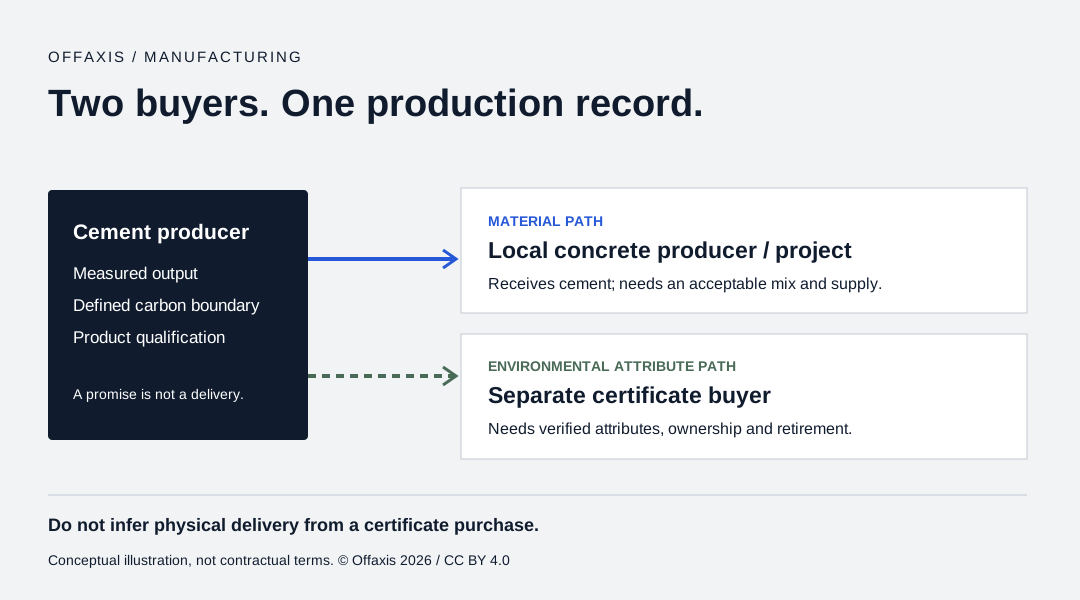
A cement truck and a corporate emissions claim can have different destinations. That separation is central to Sublime Systems’ commercial proposition: sell a material that a concrete producer can use, while a separate buyer pays for its environmental attributes. The distinction makes the business more interesting than a story about replacing a hot kiln with electricity. It also creates an accounting obligation that the physical product alone cannot satisfy.
First, follow what comes out of the process
Sublime describes an electrochemical route that extracts reactive calcium and silicate ingredients from calcium-silicate rocks or industrial byproducts, then blends them into cement. The company contrasts that route with ordinary portland cement production, which uses limestone decomposition and high-temperature clinker formation. These are supplier descriptions of the mechanism, not Offaxis measurements of energy use or emissions. [1]
The important boundary is between cement and concrete. Cement is the binder; the concrete producer still combines it with aggregate, water and the selected mix’s other ingredients. An alternative binder therefore enters an existing chain of testing, batching, transport, placement and approval. Avoiding a conventional kiln does not remove those downstream tasks.
Sublime’s product page says American Engineering Testing assessed compliance with ASTM C1157 and describes production at a 250-ton-per-year Somerville pilot. It also describes first commercial-scale facilities as being developed. A pilot’s stated annual capacity is not a record of actual shipments, and a materials test is not an authorisation for every possible structure. [2]
The second buyer does not need the same truck
Microsoft’s 26 May 2025 account identifies its purchase as environmental attribute certificates, or EACs, associated with up to 622,500 metric tons of Sublime cement over six to nine years. It separately describes a priority option to buy physical cement where location makes that practical. The announced quantities concern a future agreement, not completed deliveries. [3]
Microsoft explains the rationale through geography: a company can support production in one market without transporting that material to a distant project. The low-carbon material still needs a physical buyer. The certificate buyer pays for the associated environmental attribute rather than assuming that the same cement is inside its own building. [3]
Our commercial interpretation: this potentially gives a new producer two routes to recover the cost of changing how cement is manufactured. But it is not permission to count one environmental benefit twice. A useful contract must specify the attribute, its owner, verification and retirement, and the claims available to the material’s eventual purchaser. Public headline volumes do not reveal the unit price, payment timing or remedies for delayed production.
A pour is valuable evidence—with a precise boundary
On 5 August 2025, STACK announced a pilot using Sublime cement in part of a loading dock at a Prince William County, Virginia, data-center campus. STACK said testing received to that point, including compressive strength, exceeded its expected standards. That is customer-side confirmation of a defined field application. It does not make the whole campus a Sublime-built project or establish long-term performance across all exposure conditions. [4]
The One Boston Wharf case study provides a different evidence layer. Its project team reports placements in an interior topping slab and exterior sidewalk after local mixture development and trials. It treats this initial material as a field proof of concept, with subsequent versions still to be tested at the report’s date. The specific formulation and application matter; later product ambitions cannot be retroactively assigned to the earlier pour. [5]
For a material supplier, these trials address an adoption problem that a chemistry demonstration cannot: can the local construction chain handle the product? The next research questions concern repeat orders, approved applications and reproducible performance with different local inputs. Those are questions to investigate, rather than shortcomings we have established.
Do not turn a construction target into an operating plant
The project history is a warning against reading older announcements as current status. Sublime’s March 2024 release targeted a Holyoke facility opening as early as 2026. Senator Edward Markey’s office recorded the company’s announcement of a construction pause on 5 December 2025. The earlier schedule therefore cannot establish that the factory is operating today. [6] [7]
Status as checked on 16 October 2026: the public company product page describes a pilot and commercial facilities in development; the dated official record documents the Holyoke pause. The primary sources reviewed here do not establish resumed construction, commissioning or current commercial output. This article does not certify continued pilot operation merely because an undated marketing page describes it. Nor do these records establish the present legal or delivery status of every purchase agreement.
| Layer | Supported record | Still needed |
|---|---|---|
| Technology | Supplier process explanation and stated product validation [1, 2]. | Comparable measured energy, yield and delivered-product carbon data. |
| Field adoption | Named loading-dock, topping-slab and sidewalk applications [4, 5]. | Repeated deliveries, application-specific approvals and longer operating history. |
| Demand | Buyer-disclosed EAC agreement and separate physical-purchase option [3]. | Verified deliveries, retired attributes and disclosed contract economics. |
| Manufacturing | Pilot described online; Holyoke pause documented in December 2025 [2, 6]. | Dated restart, commissioning and actual output records. |
What would make the economics convincing?
The useful unit is a tonne of specification-compliant material delivered to an accepting customer, with a clearly defined environmental claim. A plant analysis needs electricity consumption, input preparation, yield, separation and finishing costs, transport and reject rates. Feedstock availability alone is insufficient: a widely available rock still has to be processed consistently and moved economically.
For the certificate side, look for a production-linked issuance record and a defensible comparison against the chosen baseline. Then ask whether the revenue arrives early enough to support construction or only after verified output. Both structures can signal demand, but they create different financing needs. We cannot infer either arrangement from an announced aggregate volume.
A comparison with other cement technologies should also hold the application constant. A specialised trial, a general-purpose product and an operating commodity-scale factory answer different questions. Announced carbon reductions need a stated system boundary and electricity assumption before they can be compared. “True zero” is the company’s branding, not this article’s independent lifecycle conclusion.
Offaxis conclusion: separating material from environmental attributes can widen the market for a new production process. It cannot substitute for making the material, qualifying it and documenting its output. Follow the two buyers, then reconnect their contracts to one verifiable production record.
Primary sources & further reading
- Sublime Systems: manufacturing process — Undated supplier description, checked 16 October 2026; process and input claims.
- Sublime Systems: product and validation — Undated supplier page, checked 16 October 2026; pilot description and validation claims, not a commissioning record.
- Microsoft: Building new markets to advance sustainability — 26 May 2025; buyer explanation of EACs and the announced Sublime purchase.
- STACK: data-center pilot pour — 5 August 2025; customer-issued announcement of a loading-dock trial.
- Lower-Carbon Concrete Task Force: One Boston Wharf case study — Project-team field-trial record, including the linked detailed report; checked 16 October 2026.
- Senator Markey: Holyoke project pause — 5 December 2025; official statement recording the announced pause. Its political conclusions are not adopted here.
- Sublime: original Holyoke announcement — 25 March 2024; historical project target, superseded as evidence of schedule by the later pause.
Analysis, not a product recommendation. Sources checked 16 October 2026. Offaxis has not tested the cement, audited certificates or reviewed private contracts. Historical announcements retain their original dates; supplier claims and our interpretation are distinguished above.
Related: Rondo and the steam-service contract · Related: a printed wall is part of a building