ENERGY / ENHANCED GEOTHERMAL / COMPANY ANALYSIS · 014
Fervo’s First 33 MW: From a Well Test to a Power Contract
Cape Station’s first commercial unit is a meaningful operating milestone. It is not the same evidence as a drilling record, a future expansion or a two-gigawatt approval.
Offaxis Research · 17 October 2026 · 7-minute read
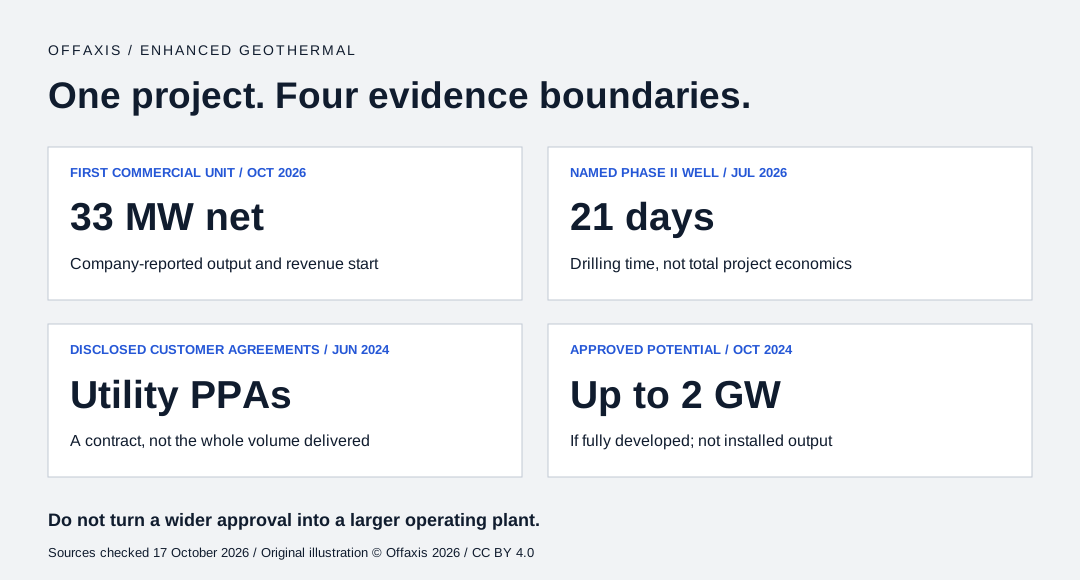
The useful question about next-generation geothermal has changed at Cape Station. It is no longer only whether a well can move enough hot water during a test. On 1 October 2026, Fervo said its first GeoBlock in Utah had reached contractual commercial operation and begun earning revenue under a power purchase agreement. That connects a subsurface experiment to a customer obligation. It does not make every future phase an operating asset. [1]
What the first unit actually establishes
Fervo’s announcement reports 33 MW of net power production for the first GeoBlock. It says grid synchronisation occurred on 24 September and commercial operation was declared on 30 September. The company describes the output as meeting the expected threshold under its PPA. Those are specific, dated operating claims, stronger than an artist’s impression or construction target. They remain company disclosures, not Offaxis verification of meter data or contract performance. [1]
Our interpretation: contractual commercial operation is a meaningful change in evidence stage. A buyer and seller have reached a stated delivery milestone. The next analytical task is to follow performance through time: net energy delivered, availability, reservoir behaviour and the costs of sustaining that output. A successful threshold test does not disclose a full operating margin.
The heat is natural; the flow path is engineered
The Department of Energy explains enhanced geothermal systems as a response to hot rock that lacks sufficient natural permeability or fluid. Controlled injection creates or reopens fractures, allowing fluid to circulate, acquire heat and return to the surface for electricity generation. The engineered reservoir is therefore part of the energy system, not merely a hole beneath a conventional power plant. [2]
For a commercial assessment, follow that chain all the way to electricity delivered. Drilling, reservoir connection, circulation and surface conversion have different measurements. A good result in one cannot be substituted for all the others. Net electrical output is more relevant to a customer than heat underground, but even a net power reading is not the same as a year of contracted energy.
A faster well is an input to the business case
In a separate 8 July 2026 update, Fervo reported completing Sawtooth 7, a Phase II well, in 21 days to a measured depth of 19,448 feet with a 7,500-foot lateral. That is evidence about a particular drilling task and design generation. It should not be merged with the first GeoBlock’s September operating record as though they were one test. [3]
A shorter drilling campaign can reduce the time that equipment and crews are committed to a well. But the whole-project cost still depends on completions, the number of useful wells, gathering infrastructure, plant equipment, connection work and the performance of the combined system. A drilling pace record does not reveal all-in capital cost per dependable megawatt. Nor does faster drilling prove that every new site has the same subsurface behaviour.
The buyer purchases a delivery obligation
Fervo’s June 2024 announcement described two 15-year PPAs totalling 320 MW with Southern California Edison. That identifies a utility-scale route to market and the duration originally announced. It does not establish that the whole contracted quantity has now been delivered, and this article does not assign that utility as the buyer of the first 33 MW without a specific supporting disclosure. [4]
The commercial proposition is to develop and operate generating assets, not simply license a drilling method. In evaluating that model, ask what the customer is entitled to receive and when. Pricing, output guarantees, scheduling, outages and remedies affect project economics. These public announcements do not provide the complete private contracts, so we leave their undisclosed terms unknown.
Do not confuse approval with installed capacity
The BLM’s 17 October 2024 announcement approved a Cape geothermal development described as capable of up to two gigawatts if fully developed. That is a potential development envelope. The first unit’s 33 MW operating disclosure has a different scope and date. Neither number is wrong merely because it differs from the other; the error is presenting them as equivalent measures of what is running. [5]
| Record | What it supports | What it does not prove |
|---|---|---|
| First GeoBlock [1] | Company-reported 33 MW net output, contractual COD and revenue start. | Full Cape buildout or long-term achieved availability. |
| Sawtooth 7 [3] | A named Phase II drilling performance record. | Complete construction cost or every future well’s performance. |
| 2024 PPAs [4] | A disclosed route to utility customers. | Current delivery of the whole originally announced volume. |
| BLM approval [5] | A larger permitted development proposition. | Two gigawatts of installed or operating generation. |
Monitoring belongs inside the economics
In its update published on 29 June 2026, Fervo reported 36 yellow-category seismic events and no red-category events for 1 November 2025–30 April 2026 under its traffic-light system. It said events above magnitude two triggered a six-hour operating pause. These are bounded operator reports, not a statement that there is no seismic risk or that conditions after April are covered by the same dataset. [6]
The business implication is straightforward: monitoring, operating limits and responses to detected events belong beside the drilling programme. Safety procedures can affect the way work is scheduled. That is not evidence of commercial failure; it is a reason to examine the actual rules and operating record rather than using a generic “always on” description as a complete risk assessment.
Fervo also published a longer production account for Project Red in April 2026. A pilot’s accumulated operating history is useful further reading, but another site’s results do not remove the need to track Cape itself. Similar technology does not mean identical geology, layouts or operating histories. [7]
Offaxis conclusion: the first commercial GeoBlock moves Fervo’s evidence beyond drilling progress and into a revenue-generating power obligation. The next proof is repeatable delivery and economics over time. Keep the operating unit, the well record, the purchase agreement and the expansion approval in separate rows before combining them into a company thesis.
Primary sources & further reading
- Fervo: first Cape Station GeoBlock reaches commercial operation — 1 October 2026; company disclosure of net output, dates and PPA revenue.
- US Department of Energy: enhanced geothermal systems — Technology explanation, checked 17 October 2026.
- Fervo: third-generation well drilling update — 8 July 2026; supplier-reported drilling milestone, not whole-project economics.
- Fervo: Southern California Edison PPAs — 25 June 2024; original announced agreements. Historical phase sizes and dates should not substitute for later operating records.
- Bureau of Land Management: Cape project approval — 17 October 2024; potential output if fully developed, not installed generation.
- Fervo: seismicity update for November 2025–April 2026 — Published 29 June 2026; event classification and operational response are operator-reported and limited to that period.
- Fervo: Project Red production account — 13 April 2026; longer pilot history at a different site. Further reading, not independent replication of Cape results.
Sources checked 17 October 2026. Original analysis, not investment advice or independent plant testing. Company performance and revenue claims are attributed; private contract pricing, audited unit economics and future phase delivery remain unverified here.
Related: a power contract is not a grid connection · Related: when equipment becomes a service obligation