SPACE / ORBITAL MANUFACTURING / COMPANY ANALYSIS · 020
Varda: Reentry Cadence Is a Supply Chain, Not a Capsule Count
Repeated returns move orbital manufacturing beyond a one-off demonstration. Scaling still requires launch slots, useful processing, reusable licensing, recovery capacity and customer-confirmed value to advance together.
Offaxis Research · Published and checked 23 October 2026
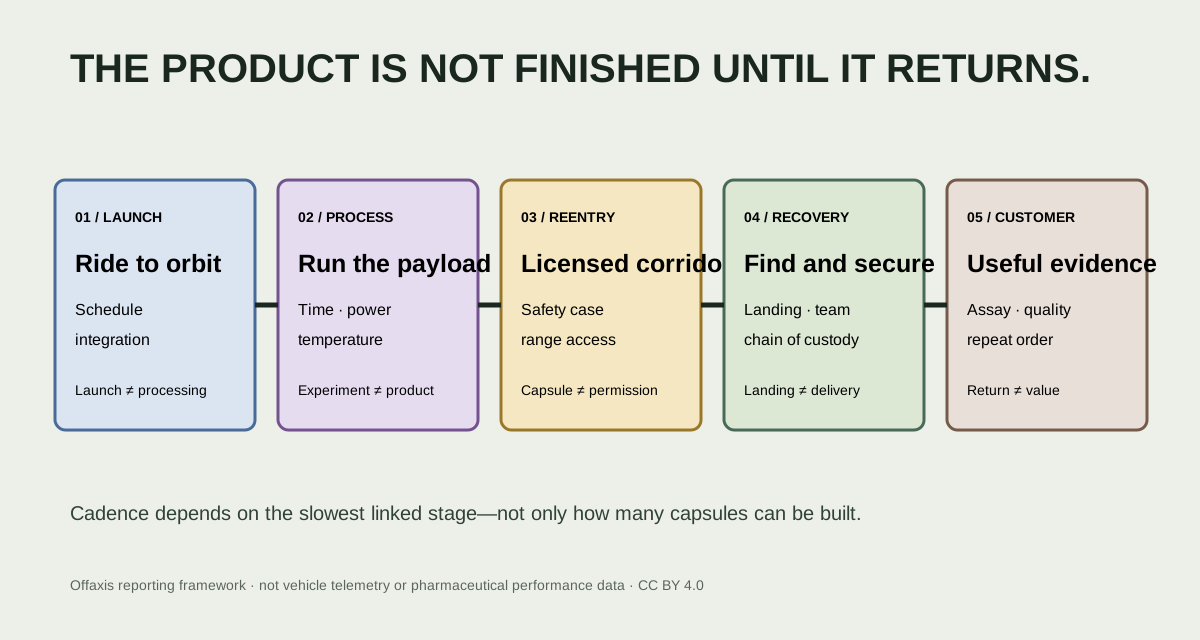
Varda Space Industries has moved from a first US return in February 2024 to repeated capsule missions, including Australian landings and additional flights in 2026. The useful milestone is repetition: orbital processing and atmospheric return are no longer represented by a single capsule. The commercial claim should stop short of “scaled manufacturing.” Flight cadence and saleable product cadence are not yet the same evidence.
The platform joins two businesses
Varda’s W-Series combines an orbital spacecraft with a small return capsule. The company markets the platform to biopharma customers seeking microgravity processing and to government customers seeking hypersonic flight data or payload exposure. These are different outputs with different buyers. A recovered experiment can create research evidence; a government payload can create flight heritage; neither automatically establishes routine pharmaceutical production.
The shared infrastructure is valuable because both customers need a controlled journey through orbit and reentry. Yet the acceptance criteria diverge after landing. A government test may be judged by telemetry and environmental exposure. A drug program needs material identity, quality, stability, regulatory development and a reason the orbital result is better than an Earth-based process.
Reentry permission became more reusable
The first FAA license authorized a single Winnebago reentry to the Utah Test and Training Range. In June 2025, the FAA said it had authorized multiple operations under one Part 450 license through 2029. That is a genuine reduction in transaction friction: the operator no longer needs a wholly separate vehicle license for every mission covered by the authorization.
It is not permission to land anywhere at any time. A mission still depends on approved vehicle configuration, trajectory, range, airspace coordination, environmental conditions and recovery operations. The FAA’s environmental documents make that ground system visible. Reentry is a service conducted through institutions and geography, not a feature stored entirely inside the capsule.
Twenty contracted returns are capacity demand, not completed cadence
Varda and Southern Launch announced an agreement covering up to twenty reentries at Australia’s Koonibba Test Range through 2028. Such an agreement matters because a return provider needs landing locations and operational partners before a high flight rate is credible. It shows planned access and commercial coordination. It does not establish twenty completed recoveries or monthly utilisation.
Company materials have also described a monthly cadence ambition. Treat the word ambition literally. The rate will be bounded by capsule production, launch rideshare schedules, orbital payload readiness, licensed windows, range availability, weather, recovery teams and customer analysis after landing. The slowest gate sets realised cadence.
The heat shield is part of the factory
NASA describes transferring and supporting production of C-PICA heat-shield technology used by Varda. Thermal protection is sometimes narrated as transport hardware separate from orbital manufacturing. Commercially, it belongs inside the production system: if the return environment cannot be controlled and repeated, the product cannot complete its route to the customer.
Vertical integration may shorten iteration between capsule, shield and payload design. It also means the company carries manufacturing yield, quality assurance and inventory responsibilities for hardware that is consumed or heavily stressed during return. The relevant economics include more than launch price per kilogram.
| Stage | Evidence available | Evidence still needed |
|---|---|---|
| Flight | Repeated launched and recovered capsules | On-time rate, anomaly history and sustained annual cadence |
| Permission | FAA multiple-operation authorization and range agreements | Mission-by-mission window availability across intended sites |
| Processing | Named orbital crystallization and research payloads | Comparable process results and useful yield |
| Customer value | Commercial and government use cases | Customer-confirmed outcomes, repeat orders and unit economics |
Return is necessary evidence, not the final evidence
A capsule on the ground proves that a logistics loop closed. It does not prove that the returned material creates enough value to pay for that loop. For biopharma, watch for disclosed analytical results, downstream development decisions and repeat programs. For government testing, watch for payload customers that move from demonstration to a recurring campaign.
The most important operating metric may therefore be less dramatic than reentry footage: time from payload acceptance to usable customer data. That clock includes integration, launch wait, orbital duration, landing, recovery, shipping and analysis. Shortening it repeatedly would make orbit behave more like an industrial location and less like an exceptional expedition.
Offaxis conclusion: Varda has demonstrated a repeatable return capability, a meaningful infrastructure advance. Its business scales only when capsules, licenses, ranges and customer learning form one dependable chain. Count successful returns, but also count useful lots, customer decisions and the time between them.
Primary sources & further reading
- FAA, 18 June 2025 — multiple-operation reentry authorization under Part 450.
- FAA — final environmental assessment for Utah reentry, landing and recovery.
- Varda — W-Series platform and supplier capability description.
- Varda and Southern Launch, 30 September 2025 — agreement for up to twenty Australian reentries.
- NASA — C-PICA heat-shield technology and Varda manufacturing support.
- Varda — W-2 landing and company account of customer markets.
Published and checked 23 October 2026. Industry analysis, not independent pharmaceutical testing or vehicle certification. Supplier claims and regulatory evidence are distinguished above.
Related: mission risk and a changed target · Related: launch and space systems · Commercial research reports